What Is Dealer Management? How to Manage a Dealer Network
Learn what dealer management is and how businesses can manage dealer records, sales, customers, orders, targets and performance across a dealer network.
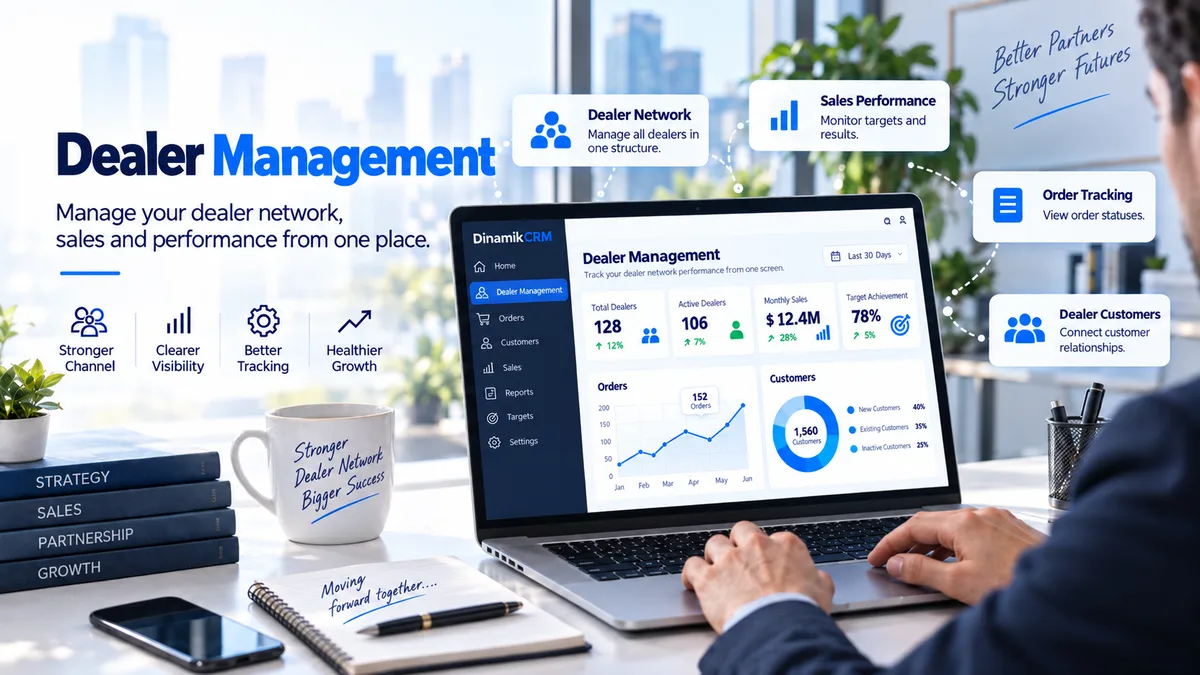
In businesses that operate through a dealer network, sales are not managed entirely by the central sales team. Products or services may reach customers through dealers, distributors, sales points or regional channel partners in different locations.
As this structure grows, keeping only a list of dealers is no longer enough. Businesses also need visibility into which dealers are active, which customers they work with, how much they sell, which orders they manage, how well they achieve their targets and which dealers require additional support.
Dealer management is the overall process of organizing, monitoring and improving this network in a more structured and measurable way.
What is dealer management?
Dealer management is the process of organizing, monitoring and developing a sales network made up of dealers, distributors, sales points or channel partners.
It is not limited to storing dealer contact information. In a well-structured dealer management process, dealer records are evaluated together with customers, sales opportunities, orders, targets, activities and performance indicators.
This allows the central team to understand not only how many dealers it has, but also how the network is performing and which channels are stronger.
Why is dealer management important?
As the number of dealers grows, information can become spread across spreadsheets, emails and personal notes. The latest status of a dealer, its sales volume or customer portfolio may become knowledge held only by certain employees.
This can reduce visibility across sales, operations and management teams.
A structured dealer management process can help businesses:
- Distinguish active and inactive dealers more easily.
- Compare dealer sales performance.
- See dealer customers and customer activity.
- Evaluate orders and sales within the dealer context.
- Track targets and actual results.
- Identify dealers that may require additional support or follow-up.
How should a dealer network be managed?
One of the most important principles in dealer network management is to define every dealer within a shared system and connect related commercial activity to that record.
The process can be structured around several core steps.
Centralize dealer records
Basic information such as company name, contact details, region, authorized contacts, responsible users and current status should be stored under a single dealer record.
This reduces the need to search through multiple files and helps everyone work with the same up-to-date information.
Classify dealer status
Not every dealer will be equally active. Some may generate regular sales while others may not have created new business for a long period.
Classifying dealers with meaningful statuses such as active, developing, follow-up required or inactive can make the current state of the network easier to understand.
Define regions and ownership
Region information becomes increasingly important in larger dealer networks. Businesses should clearly define where each dealer operates and who within the central team is responsible for managing that relationship.
This reduces confusion around ownership and helps follow-up activities stay more organized.
How should dealer customers be tracked?
In dealer management, it may not be enough to see only the dealer itself. Knowing which customers each dealer works with can provide a clearer view of the true commercial potential of the channel.
Linking customer and company records with the relevant dealer allows the central team to evaluate customer portfolios by dealer more effectively.
This can be especially important when multiple dealers operate in the same region or when customer ownership needs to remain clear.
To manage dealer records, customers, sales and performance through a shared structure, explore our Dealer Management Software .
How should dealer sales be tracked?
Dealer sales tracking is not only about seeing total sales value. Businesses should also evaluate how much each dealer sells, how sales change over time and how effectively targets are being achieved.
Dealer-level sales visibility makes it easier to identify high-performing dealers. It can also help detect dealers whose sales are declining or that have not generated new activity for an extended period.
Connecting sales opportunities to dealers is equally valuable. This makes it possible to evaluate how many new opportunities each dealer creates and how effectively those opportunities convert into sales.
To learn more about managing active deals throughout the sales process, explore our content on sales opportunity management .
How should dealer targets be managed?
Assigning sales targets to dealers is not enough on its own. Targets should be defined for specific periods and regularly compared with actual results.
For example, dealer performance can be reviewed using monthly, quarterly or annual targets.
Target achievement should not necessarily be used as the only performance indicator. It becomes more meaningful when reviewed together with sales volume, growth, customer count and order activity.
How is dealer performance measured?
Measuring dealer performance only by revenue can create an incomplete view.
Useful dealer performance indicators may include:
- Total sales value
- Sales growth rate
- Target achievement rate
- Number of sales opportunities created
- Opportunity-to-sale conversion rate
- Number of active customers
- Number of orders
- Average order value
- Date of the most recent sale or order
Reviewing these indicators together can help businesses identify not only the highest-selling dealers, but also those that are growing or showing future potential.
Why should dealer orders be tracked separately?
After a sale is completed, the process often continues through order processing, preparation, shipment and delivery.
Connecting dealer-generated orders with the relevant dealer and customer keeps the post-sales process visible within the channel context.
This allows the central team to see how many orders are coming from each dealer, which orders are still open and whether any delivery issues are occurring.
To learn how orders can be tracked by status, owner and delivery date, explore our Order Tracking Software .
Why is dealer communication history important?
When conversations with dealers remain only in personal email accounts, phone calls or messaging applications, valuable business history may be lost.
Linking meeting notes, calls, tasks and next follow-up dates to the dealer record makes it easier for another employee to understand the relationship when needed.
This can also help identify dealers that have not been contacted for an extended period.
Is Excel enough for dealer management?
Excel can be practical at the beginning for a small dealer network. Basic details such as company name, contact information, region and sales value can be stored in a single spreadsheet.
However, as the number of dealers and transactions increases, several challenges may appear:
- Multiple versions of the same file may exist.
- Information may become outdated.
- Customer and order relationships become harder to track.
- Activity history may be lost.
- Reporting may require manual data consolidation.
- Visibility across teams can decrease.
As the dealer network grows, managing customer, sales, order and performance information within a connected system becomes more sustainable.
How can CRM support dealer management?
A CRM system is not used only as a contact directory in dealer management. Dealers can be treated as part of the broader customer and sales process.
For example, a dealer record can provide access to related customers, sales opportunities, orders, activities and performance information.
This approach gives the central team better visibility into the commercial relationship with each dealer and helps move channel management away from disconnected files toward a shared data structure.
Common dealer management mistakes
Several common mistakes can make it harder to scale and manage a dealer network effectively.
Focusing only on sales value
Sales value is important, but customer count, growth, opportunity creation and activity levels should also be considered.
Not keeping dealer data up to date
Outdated contact details, decision-makers or dealer status can create operational problems.
Not assigning clear ownership
If it is not clear who in the central team is responsible for each dealer, follow-ups and necessary actions may be delayed.
Keeping dealer customers in separate systems
If the relationship between a customer and a dealer is not visible, it becomes harder to evaluate channel performance accurately.
Separating orders from the sales process
Losing visibility after the sale has been completed can create problems in delivery, customer satisfaction and dealer relationships.
Which businesses need a dealer management system?
A dealer management system is particularly useful for businesses that use indirect sales channels in addition to direct sales.
Examples include:
- Manufacturers
- Wholesale businesses
- Distributors
- Distribution companies
- Franchise networks
- Businesses with regional sales channels
- B2B sales organizations
As the number of dealers grows or customer, sales and order activity becomes more complex, the need for centralized management increases as well.
Conclusion
Dealer management is not simply about maintaining a list of dealers. It is about managing the relationships between dealers, customers, sales, orders, targets and performance in a connected way.
A structured dealer management process helps businesses understand which dealers are active, how the network is developing and where additional support or follow-up may be required.
When the dealer network is small, spreadsheets or simple lists may be sufficient. As the number of dealers, customer portfolio and transaction volume grow, using a centralized CRM becomes a more sustainable approach.
With DinamikCRM, you can manage dealer records, customers, sales, orders, targets and performance indicators in one shared structure and manage your dealer network from one place .
5 Common CRM Mistakes Sales Teams Make
Explore common CRM mistakes sales teams make, from using CRM only as a contact list to working with outdated pipeline data, and learn how to improve adoption.
Read More
How Does CRM Software Affect Sales Performance?
Learn how CRM software can support sales processes through lead tracking, opportunity management, pipeline visibility, follow-up tasks and reporting.
Read More
B2B Proposal Management: How to Manage the Process from Proposal to Sale
Learn how CRM can help B2B sales teams manage proposals, opportunities, follow-up activities and proposal outcomes more consistently.
Read More
What Is Lead Management and How Does It Work?
Learn how businesses capture, evaluate, assign, follow up and convert potential customers into qualified sales opportunities.
Read More
How to Manage Customer Acquisition with CRM
Learn how to build a measurable customer acquisition process, from defining your target market and managing leads to opportunities, sales conversion and customer acquisition cost.
Read More
What Is Sales Opportunity Management?
Learn how sales opportunities can be managed through stages, expected values, close dates, activities and performance metrics.
Read More